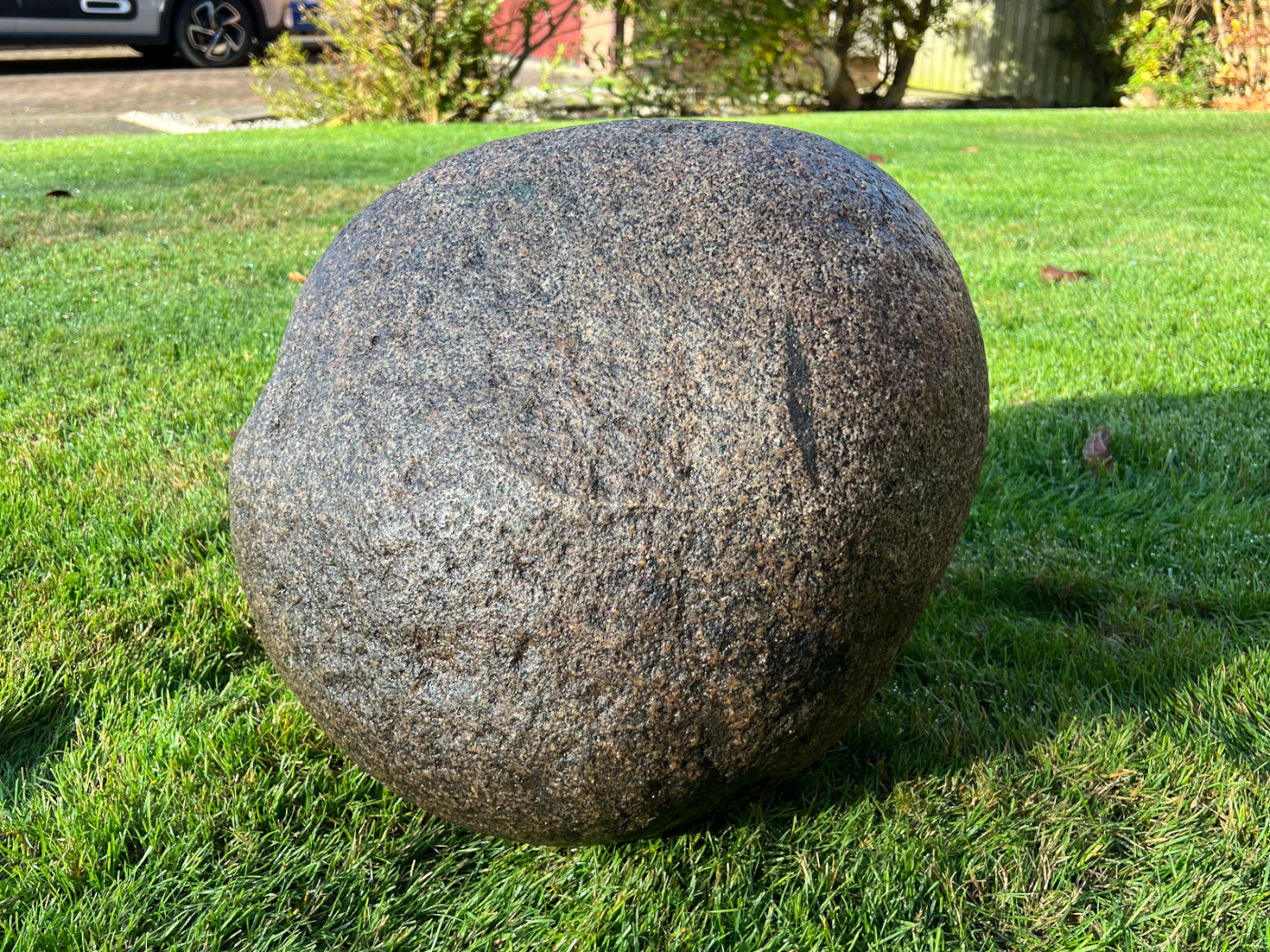
 Historic Stones
The history, excavation, and relocation of a lost historic lifting stone in
my home town.
David Brodlie
Historic Stones
The history, excavation, and relocation of a lost historic lifting stone in
my home town.
David Brodlie
Guest article by David Brodlie
The Old Loans Stone
This story starts back in 2018. I was a young, impressionable 23-year-old discovering strength training and the intriguing, yet almost unknown, culture of stone lifting right here in my native Scotland. After coming across Peter Martin’s research, published on the Old Man of the Stones website1 I quickly became obsessed: I wanted to learn as much as possible about this forgotten culture and, of course, participate in it. That first seed took hold of me, and I’ve been researching, finding and lifting historic stones ever since.
A few years down the line, I found myself reading another one of Peter’s articles. It was focused upon stones in Ayrshire, and I found a curious contents page entry named “Loans Lifting Stone”. I grew up in the village of Loans, so this immediately grabbed my attention. It is a small linear village on the West Coast of Scotland. Set amid farmland on the outskirts of Troon, it has a quiet character shaped by an agricultural past. It transpired that Peter had found a historic lifting stone a mere 300 yards from my childhood home. It became clear that the stone he referenced had been partially buried at some point outside the old blacksmith’s, opposite the petrol station - a spot I frequently walked past in my youth. By this point, I had travelled the length and breadth of the country to find and lift historic stones, and yet here we have one in my home village!
Historic stones in Ayrshire and Galloway
Peter Martin’s research into Gaelic strength culture and traditional stone lifting was without equal. He studied, researched, and found a large number of forgotten historic lifting stones all over Scotland. It is with thanks to him that we have the history and access to these relics of strength. He had a suspicion that the Gaelic culture had spread as far as the South West, and it turned out he was right.
Just outside Girvan lie the Blue Stones of Old Dailly. These two stones were known as charter stones which used to sit at the altar of the 14th-Century kirk.
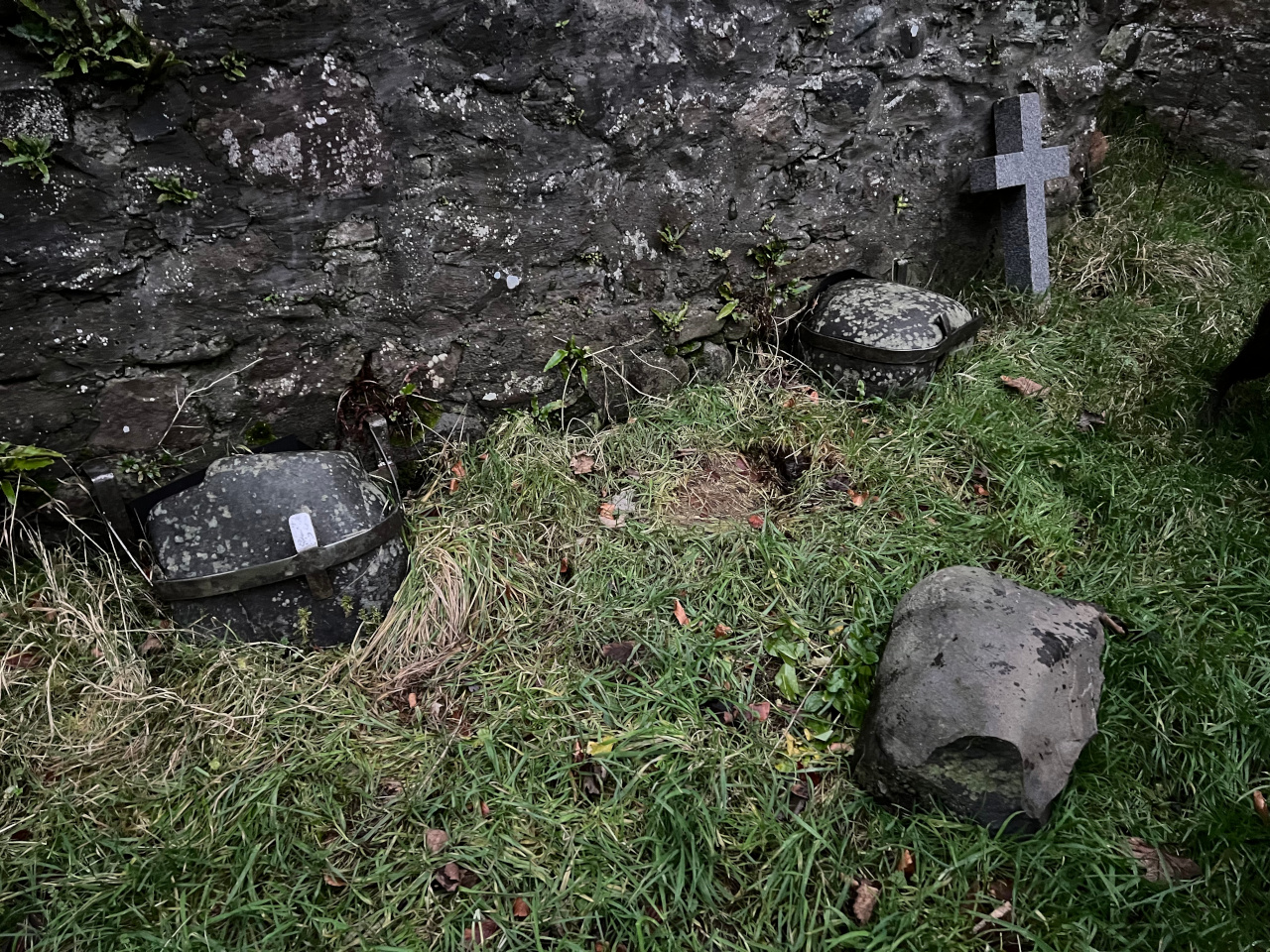
There are several traditions attached to the Old Dailly Blue Stones. One of these tales states that in ancient times they were Sanctuary Stones, and if wrongdoers, debtors in particular, placed their back against them they could not be apprehended. In Scotland, these Sanctuary Stones, or Charter Stones, were common in most churches.
Another tradition claims that the stones are possessed with mystical powers, capable of bringing good fortune to those who touch them, and in some cases, the power to cure certain illnesses. For centuries, the size of the stones meant they were also used as a test of strength for local youths.
Among the last people to lift them was Steve Jeck, who documented the stones in his 1996 book Of Stones and Strength.2 The stones were the topic of a fierce debate between the people of Old Dailly, and the village of Dailly, less than 4 miles away, after the parish and population moved to the new village in the 18th Century.
In 2001, South Ayshire Council decided to shackle the stones to the walls of the crumbling kirk to prevent them being removed. It is worth noting that at no time did Historic Scotland advise the council to strap the stones for fear of possible theft. The decision to do so is not fully recorded within council records either. Peter suspected an abuse of power by South Ayrshire Council, and had contact with Historic Scotland who agreed that the stones should be released.
More locally to Loans, there was the Leper’s Charter Stone in Kingcase, Prestwick. Aside from also being a charter stone, it was supposedly used by the locals as a test of manhood, and became associated with Robert the Bruce. The tale goes that Bruce bathed in a holy well – now known as ‘Bruce’s Well’ - which subsequently cured him of leprosy.3 The stone was destroyed after English Dragoons encamped at Bruce’s Well somehow managed to break it. The pieces were collected and carefully kept by the freemen of Prestwick. They were later incorporated into the walls of the old St Ninian’s Chapel.
Other lost stones in the local area include the Dreghorn Stone and the Ladykirk Stone in Monkton. Further south in Galloway, there is the Putting Stone of Robert Burns near Dumfries, and a stone located at Whithorn Priory which Peter photographed.
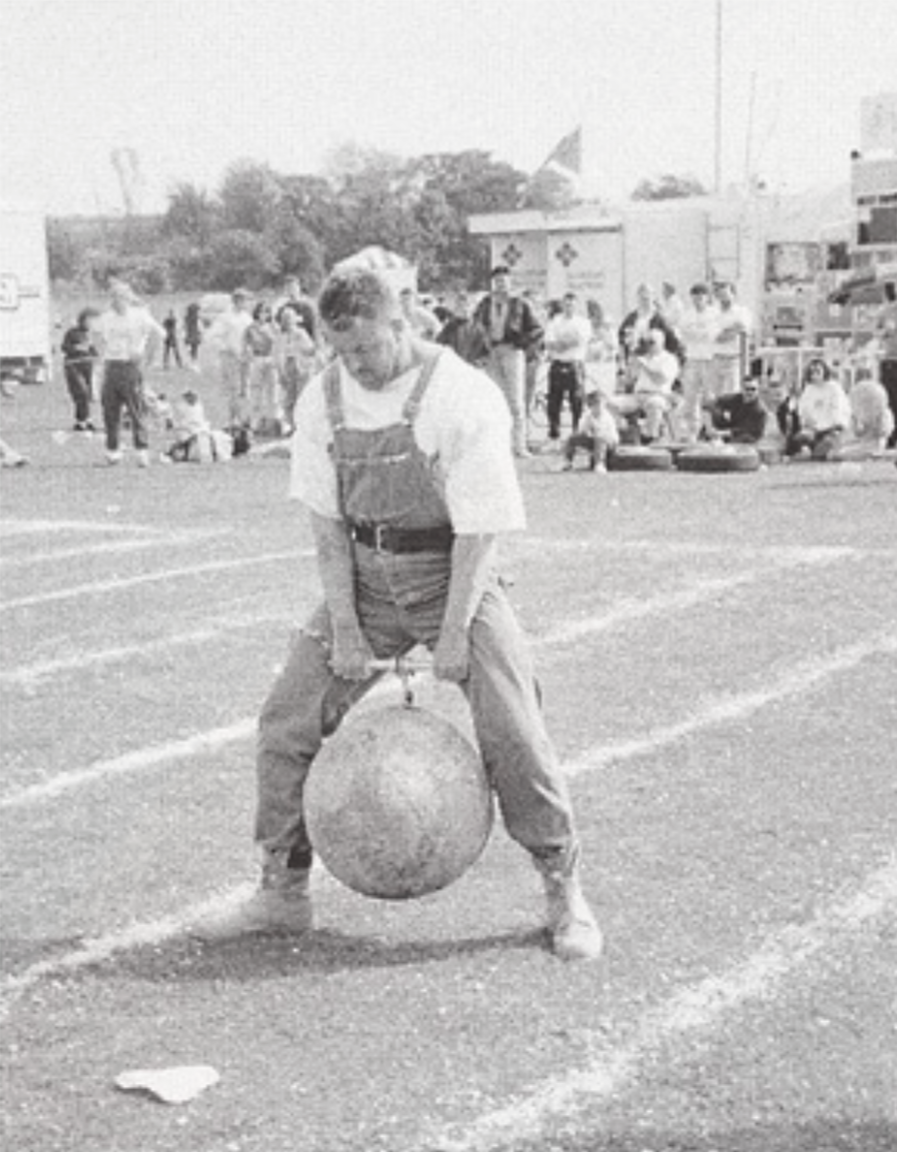
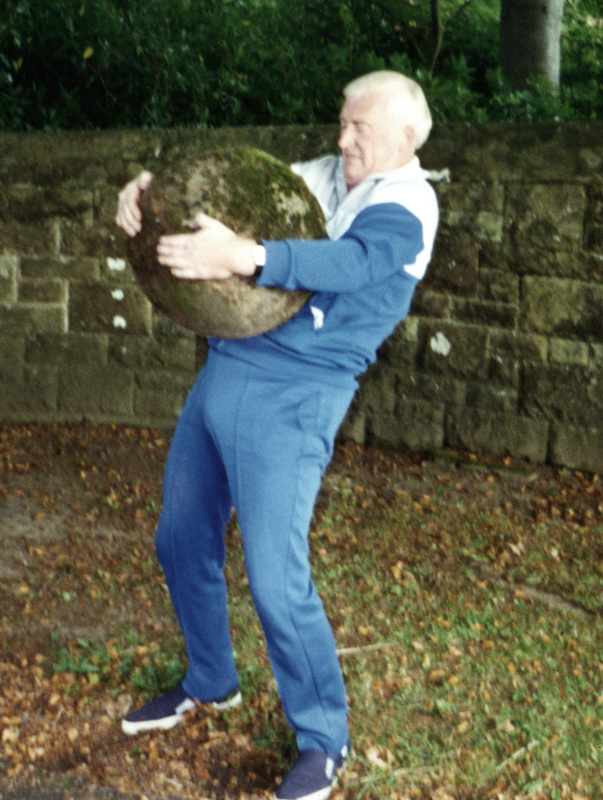
What is quite clear, however, is that for some time up to the 19th Century, there was a distinct strength culture in Ayrshire, Galloway and the Borders. We are aware that especially in Galloway and Ayrshire there was a heavy “Foreign Gael” influence, and that stone lifting was a big part of Gaelic Culture. In fact, it was only a few generations ago that almost everyone on the Island of North Uist had a relative who lifted heavy stones just to prove their strength. Perhaps it was just the gruelling nature of rural life that demanded a practical level of strength. It would have been essential for farming communities to have some idea as to who was a capable worker, and who was not. There is no reason this culture did not stretch as far south as Galloway.
The evidence and history of the Old Loans Lifting Stone
There are numerous sources citing the Loans Lifting Stone historically significant to local customs. Sadly, the late Peter Martin did not complete his book on the history of Scottish Stone Lifting Culture, aptly named “Twixt the Stone and the Turf” (a reference to lifting a stone up from the ground so the wind might pass under). However, the unfinished draft is widely circulated in the stone lifting community; a copy of which can be found on thedinniestones.com.4
The contents page lists a number of stones in Ayshire and Galloway in the unwritten Chapter Seven, The Stones of the Lowlands and Southern Uplands, notably the Loans Lifting Stone. Despite not writing this chapter before his passing, we are fortunate to have other sources from Peter. He mentioned in an online forum5 the following:
Its mere existence only cements the stone lifting culture that existed in Ayrshire which always had strong links with Gaeldom, and hence the reason why Ayrshire has lifting stones and other areas [have] nothing. The stone is easily seen, it is half embedded into the pavement and is very similar to the Inver Stone. My dilemma is that on approaching the authorities to dig out and display it properly to make it available for lifting, I know that I will have to overcome fears of big ignorant grunts lifting the stone and perhaps breaking it.
Lastly, in an email in 2013 to fellow stone lifting enthusiast James Grahame, he wrote regarding the Loans Stones:
I have the history. The stone exists but it is half submerged in the pavement… I will come back to it later.
Peter was told by elder Loans residents, including the former village post master James Clarke, that the stone shown in historic photographs was a “loupin stone”. A “loupin stone” was used to assist mounting a horse. There are many examples of loupin stones in Ayrshire and they are certainly not round, oval granite. The very idea of using a round stone for this purpose clearly shows it would be unsuitable. When Peter and James Clarke went to view the Loans stone, James instantly agreed it clearly could not be a loupin stone. He suggested this rumour could have originated from the mere fact it sat outside the blacksmith’s.
In the 2009 book Legendary Ayrshire, author Dane Love mentions the Loans Lifting Stone as a significant cultural relic:6
Another Ayrshire village that had a lifting stone was Loans. By the side of the road can still be found the old lifting stone that was used by locals to test their strength.
His research had been obtained mostly through oral communication from a Troon resident at an event he was speaking at. Again, this oral history is extremely common when it comes to lifting stones.
Actual written history of the Old Loans Stone has been hard to track down. However, efforts are being made to obtain more of Peter’s research. That being said, I think the stone was possibly associated with Robertloan House, part of the old clachans of Loans. There were rumoured to be three separate stones, all of different sizes which sat outside the old blacksmith’s. Locals told me the challenge was to carry the stones across the main street to prove your strength.
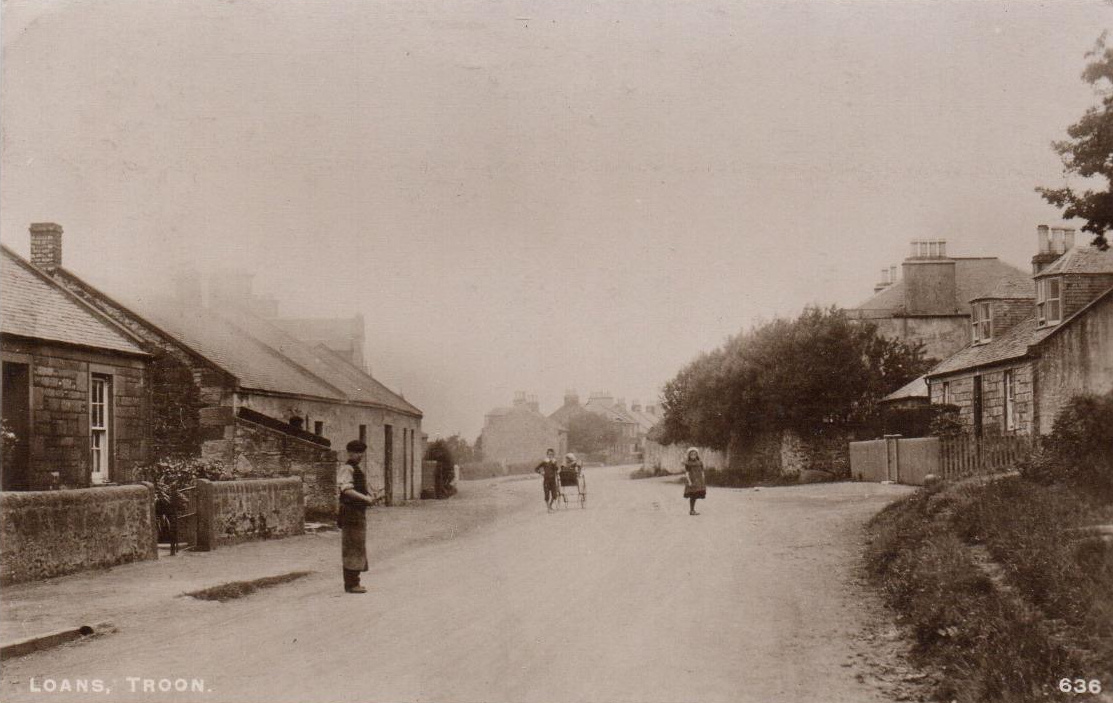
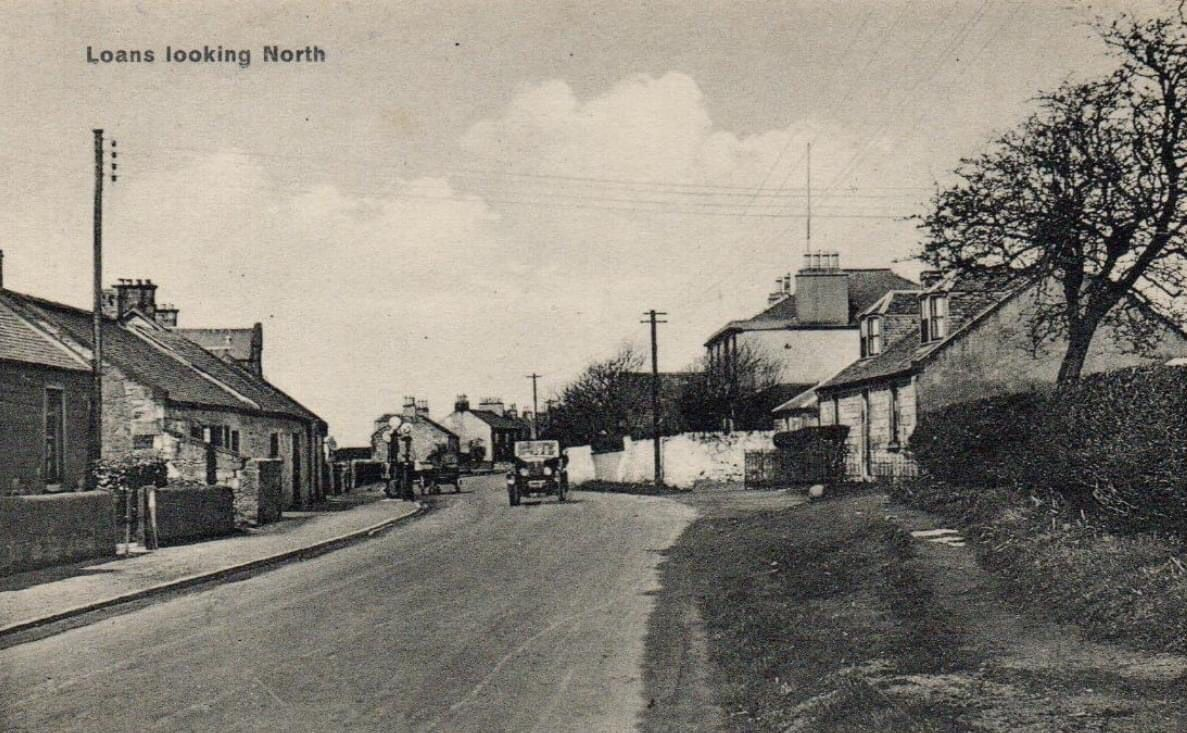
After an appeal on a local Facebook group,7 I was sent two photographs. Both show the Main Street in Loans, with the blacksmith’s on the right side. The Old Loans Stone is clearly visible in both, sitting against the wall and fence of the blacksmith’s.
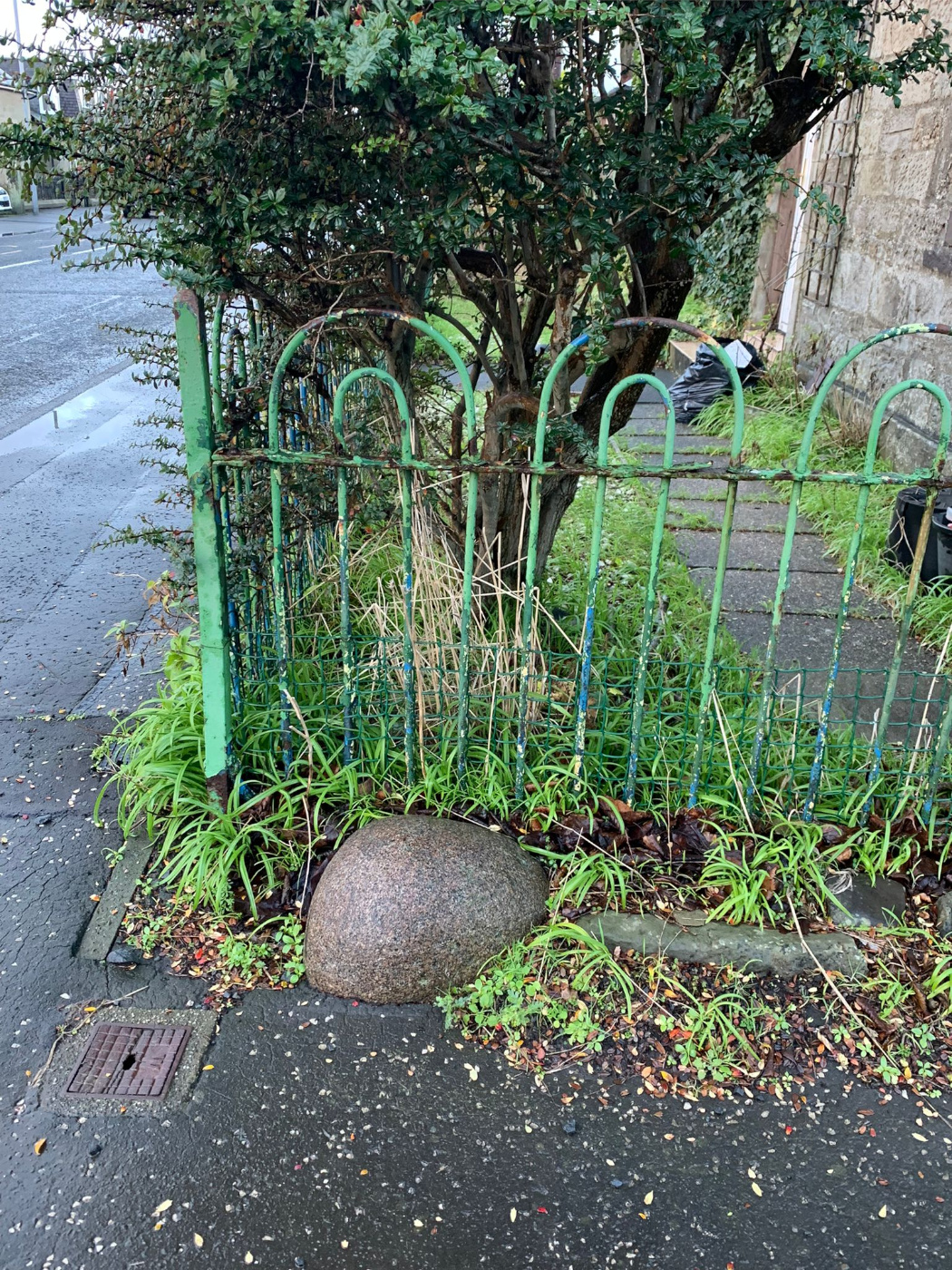
I visited the old blacksmith’s to see the stone for myself. Just like Peter Martin said, while the stone is embedded in the pavement, it’s easy to spot.
Approaching the Community Council
In early 2023, I felt the next step was to make contact with the Loans Community Council. I was hesitant to go directly to South Ayrshire Council as they had a proven track record of firmly shutting down anything to do with lifting stones. By this, I am referring to their reluctance to partake in any discussion about releasing the Blue Stones of Old Dailly from their shackles. I therefore contacted chairman David Chalmers, who invited me along to their monthly community meeting to give a presentation.
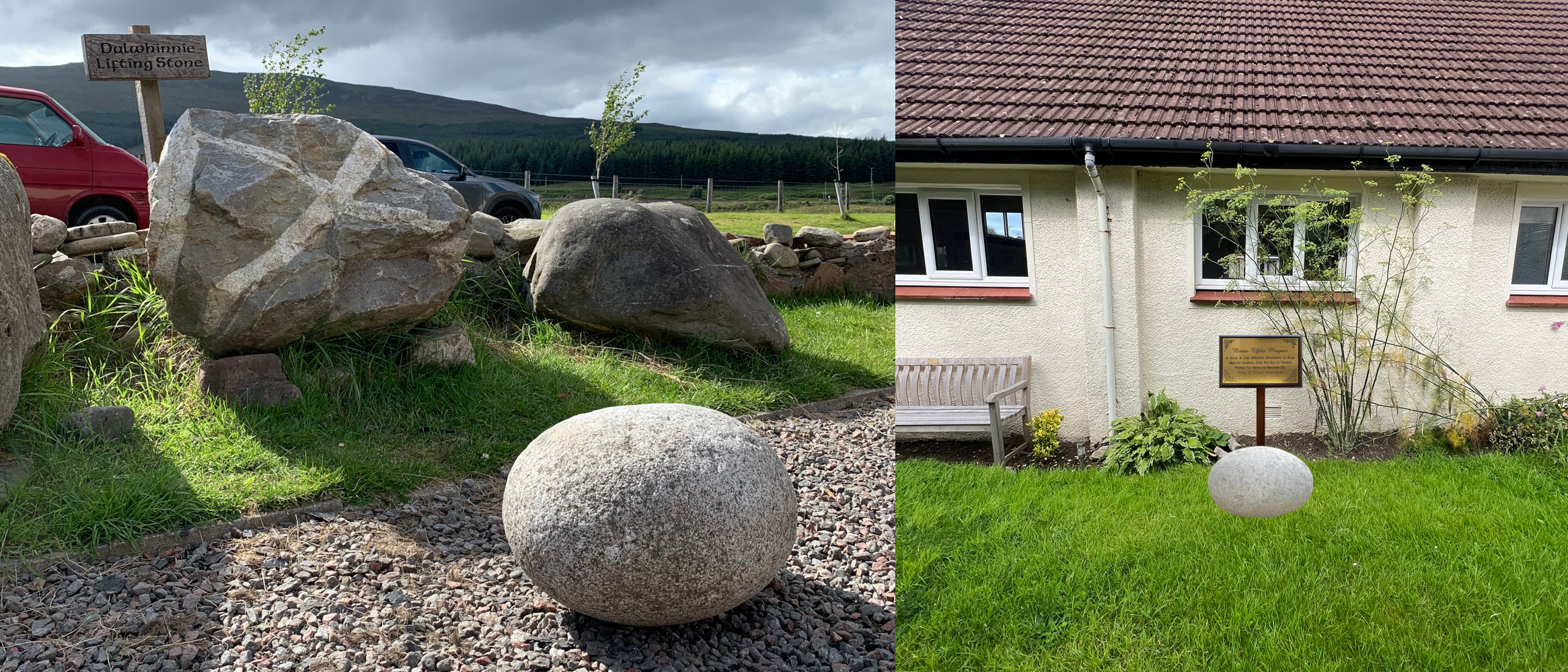
So in September 2023, I went along to the Loans Village Hall, equipped with photos and modelling a Smash & Pass stone lifting T-shirt, and made my pitch. I talked about what exactly historic lifting stones are, their cultural significance, and the resurgence in lifting them in recent years. I then spoke more specifically about stones in the South Ayrshire region, before finally getting to our very own one just along the road from where we had all gathered. I made proposals about relocating it to the hall to ensure the continuation of this forgotten custom. It went down very well, with excitement filling the room at the revelations we had something so culturally significant in our village. The timing happened to coincide with the council’s application for a funding grant to rejuvenate the Village Hall gardens. Their idea to have history boards in the garden could not have worked out better with my idea to relocate the stone and immortalise it with a Dalwhinnie-style plaque. You can see below the concept I created for them.
The tone was set. I had the backing of the community council. The next step was awaiting funding and permission from the council to proceed.
The arrival of Morgan Price
It was July 2025; nearly 2 years had passed since my presentation at the council meeting. I had kept regular contact with the chairman, David, and was aware that funding had since been granted earlier in the year. We were on the right track. However, it still left the awkward question of logistics - how exactly do we dig up this stone? Despite my repeated efforts of doing paid ground works during the pandemic, I am no ground engineer. Everything about the stone was a mere estimation - the depth, the size and weight. Was there anything under the stone, such as cables, that could interfere? Was the stone jammed in between the pavement and the fence? Would we need to break up part of the pavement to safely remove the stone? These were major challenges that I alone did not have the knowledge to solve. With that being said, I was suddenly copied into an email chain with David and someone called Morgan. Morgan is from the south of England, and had recently discovered stone lifting. Having relocated to Troon for work, he had come across the tales of the Old Loans Stone and independently contacted the Community Council, much the same way I had a few years before. A subsequent email from Morgan explained that he was an engineer for Network Rail with the expertise to remove the stone safely and professionally. This was the missing link the council and I had been looking for! It was time to set up a meeting…
The final plans to excavate
David Chalmers, Morgan Price, and I arranged to meet at the Old Loans Inn in the beginning of September 2025. Over a beer, we got straight to the point. To my amazement, David was insisting that we excavate the stone “as soon as possible”. This was a pinnacle moment for me - I had been researching and lobbying for this moment for the best part of 4 years by this point. It was staggering that it had actually come to this.
We talked further about logistics, and my main concern of how easily we could remove it from the ground. Morgan was very confident it would not be much hassle. He even felt we would get away with not having to break up the pavement which entombed one side of the stone. After ironing out some more technicalities, we set a date to attempt to liberate the stone - the 23rd of October 2025.
Excavation day
5am. I climbed into my car outside my house in Greater Manchester to begin the four-hour drive to my home village of Loans. Today was the day I had been hoping would come for some time. This was something many people through the years had wanted to see - Peter Martin, James Grahame, Jamie McGregor, to name but a few stone historians and lifters.
We planned to meet at the stone at 10am. Morgan had paid a visit to the homeowners of the old blacksmith’s the week before to let them know what was being planned. Their garden fence stood right up against the stone and so this was the last of several courtesy calls to keep them in the loop. He gave them a document I created explaining the history of the stone and background information on exactly what Historic Stone Lifting is. They were intrigued and fully supportive of the plans to resurrect and relocate the stone for future safeguarding.
It was at the stone that I met Morgan and his colleague, Tony Fox. Tony was a well-built rugby lad, and had kindly volunteered his time to help with the project. The weather was excellent - crisp, clear sky, sun shining down with a slight bite in the wind. The ground was soft and so, armed with our trowels, we started digging. The soil either side of the stone came away very easily. We had estimated the stone to be roughly 70-80kg (154-176 lb), but it soon became evident it was going to be significantly bigger than that!
We kept digging, and digging, but still the shape of the stone seemed to sink deeper into the earth. We quietly became more grateful that there were three of us there to eventually muscle it out! As we dug, we began to see a bit of movement in the stone. We started with the crow bars, and began to pry the stone from the ground it had sat in for the past century. More and more movement resulted. It was clear Morgan’s prediction of not needing to touch the pavement was correct. The council had been predictably lazy over the years with the tarmac and, thankfully, had set it around the stone and not on top of it.
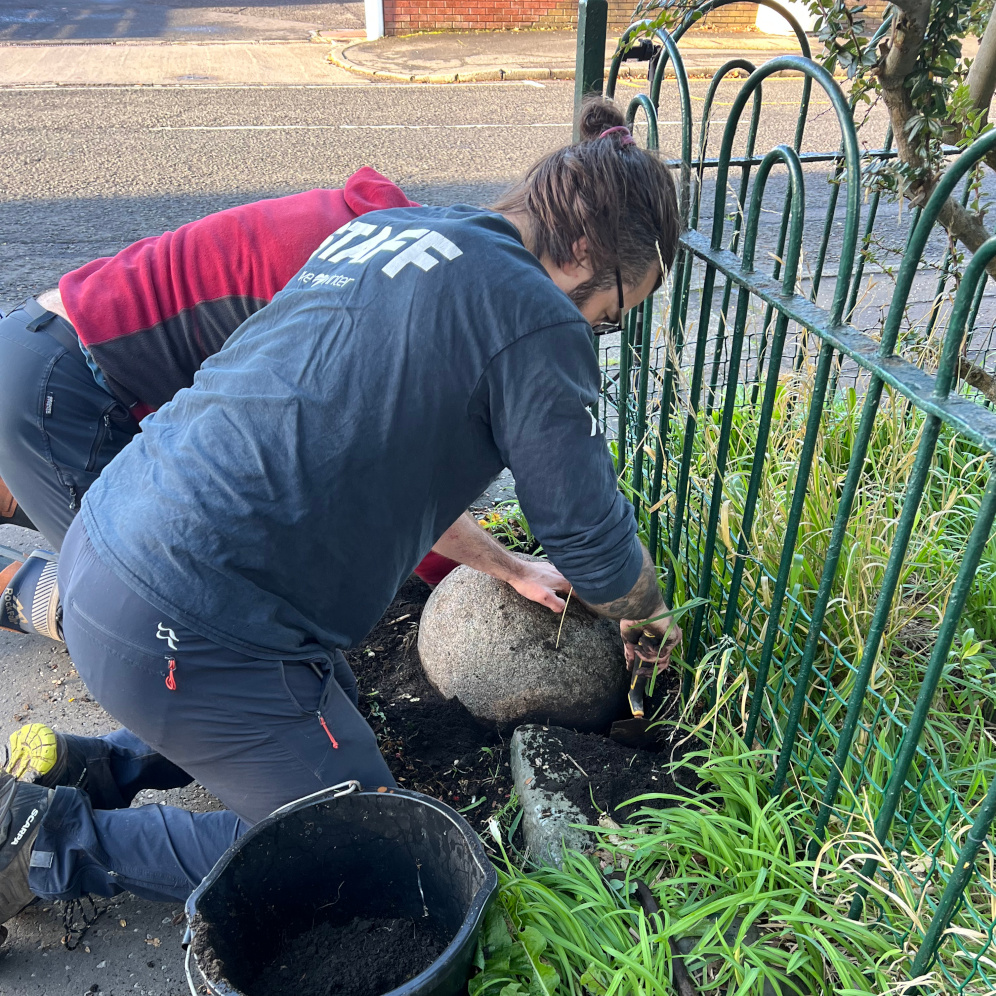
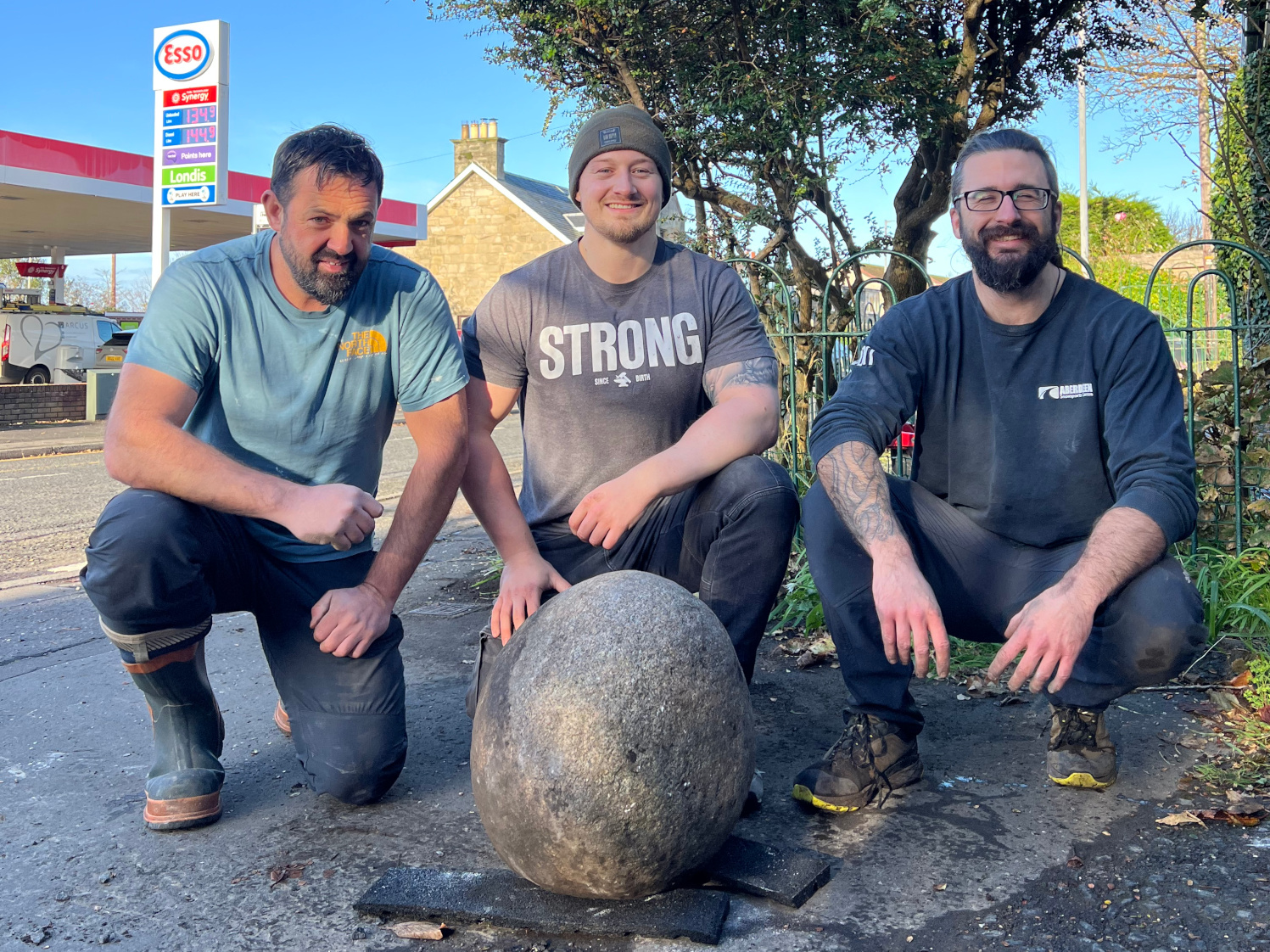
With a final squeeze of the crow bar from Tony, Morgan and I got our hands around the top and rolled it out of the ground - it was massive! Smooth to touch, with an almost pyramid shape. It appeared heavily weighted on one end with a slight point at the other. It was a classic example of a lifting stone. I could not believe my eyes! It had finally happened! We all shook hands with sheer joy of what we had accomplished.
We had a quick examination of it before weighing it. It was in great condition, with no obvious cracks or damage from the excavation or years of being partially buried. There were some slight paint marks from the iron fence it had been propped against - blue, yellow, and green. I suddenly had a childhood flashback to the now green fence, once being blue. We set up the scales which were a basic sling type. I heaved up the handle with the scales and stone dangling beneath, and to all of our amazement, Morgan announced “112kg!” (247 lb). We have a proper challenge here! A long shot from my original estimation of 70kg (154 lb). The excitement grew for the first lift of this lost local custom.
Morgan kindly offered me the first lift. Having grown up 300 yards along the road from the stone, it was a true honour for me to be the first lifter of the stone in this century, and likely the first lift in a hundred years. I bent over the stone, and with some disbelief of what I was about to do, I took my grip. I pulled it into my lap with ease. Once in the lap, I squeezed it tightly to my chest and stood up straight with it. I could not hide the smile from my face! A local lad, who grew up here in this small village, lifting a long forgotten traditional lifting stone; the feeling was indescribable! What an honour.
Morgan then stepped up, and got an easy pick off the ground into his lap. With a huge smile beaming from his face, he repositioned it on his lap before standing with it. He gently placed it back down before shaking hands with me.
Up stepped Tony. A rugby lad, he had never done any stone lifting! To be honest, he took some convincing to have an attempt. However, he eventually stepped up. His technique, or lack thereof, was evident given his extremely wide stance and attempt to wrap his whole arms around the stone to find a grip. Having said that, after an initial fail, he found a grip which worked for him, and he lifted it around 10 inches off the ground - a successful lift! “Twixt the Stone and the Tarmac” you might call it. This is what stone lifting is all about for me - seeing genuine people, try and try until they finally succeed. This is literally what the history of stone lifting is, and to see it replicated in the modern world really filled me with joy.
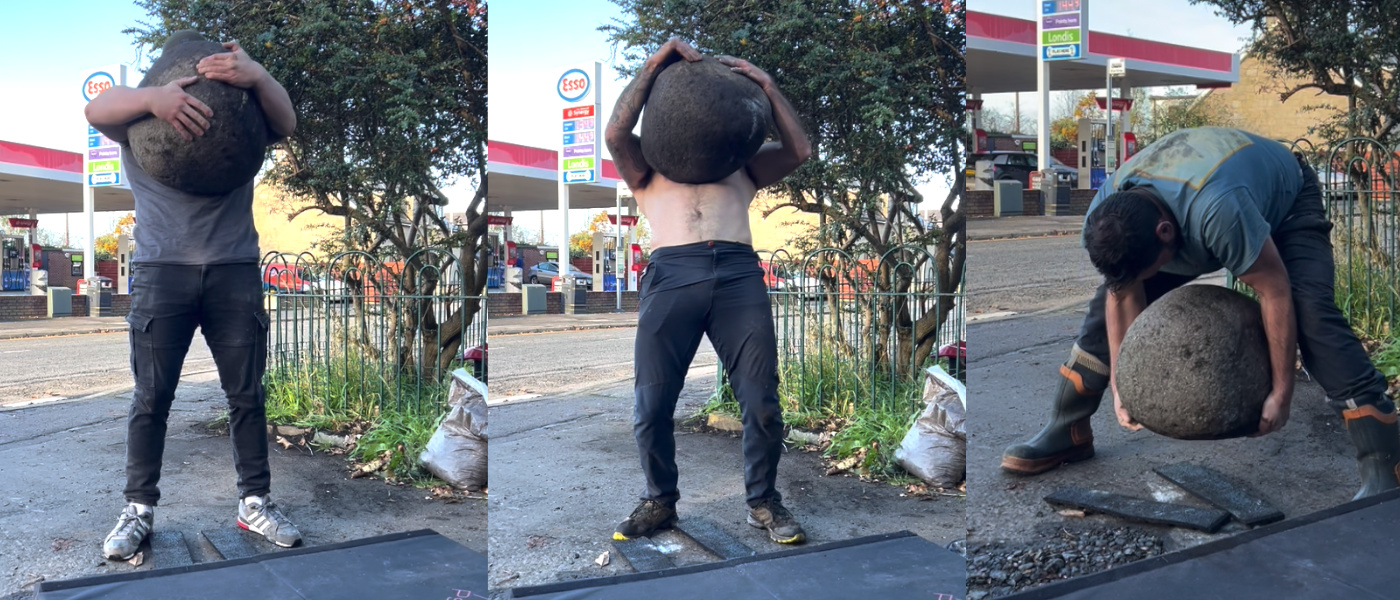
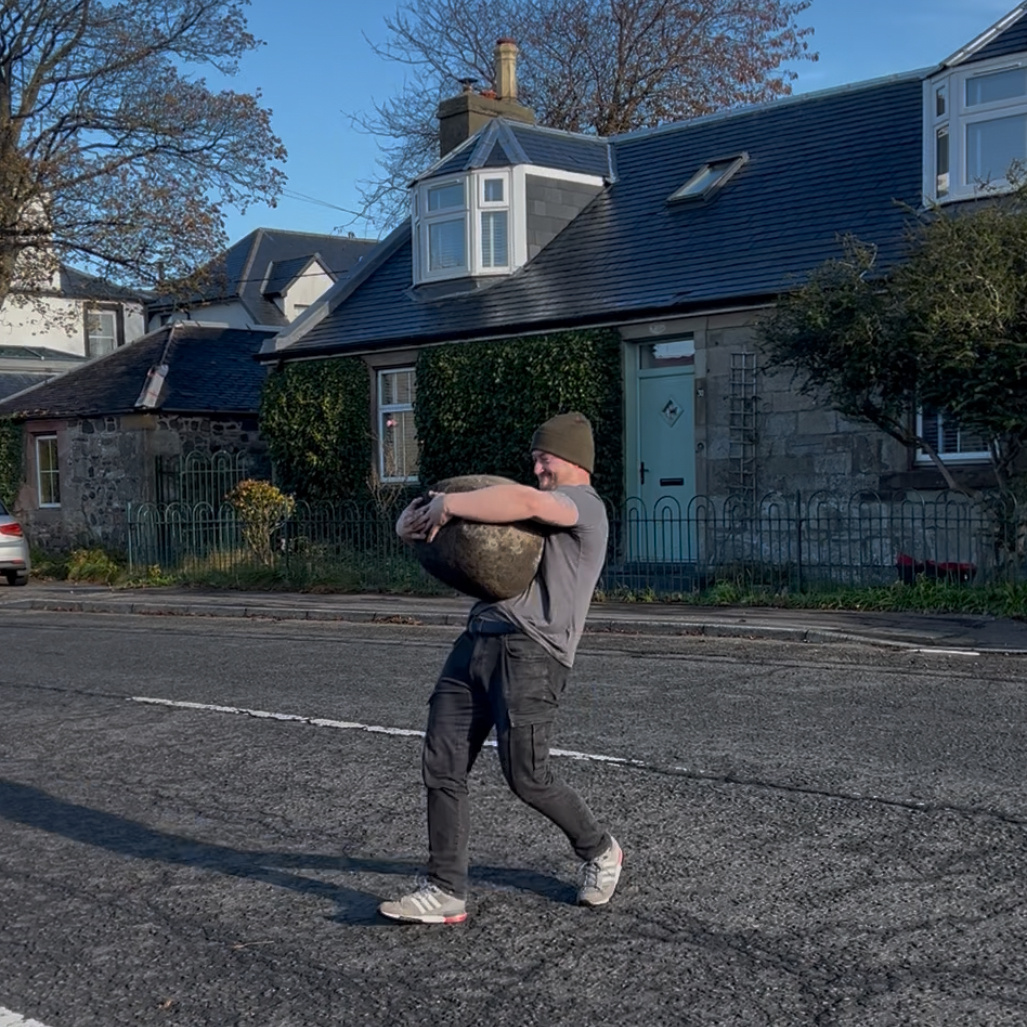
Before we loaded it into the car, I wanted to recreate the traditional lift of carrying the stone across the road. This would be a fair challenge, not only because of the sheer weight of the stone, but the fact that the Main Street in Loans is a very busy road. It is a main connector for people commuting in and out of Troon. Therefore, the timing of this had to be precise to ensure a safe lift. I was confident in my abilities to carry it across and back again, it was just the added difficulty of doing this between traffic. I positioned Morgan across the road to advise me when the road was clear. We got a decent gap which allowed me to carry it across, then back again. This was genuinely a hefty physical ask mainly due to the very unbalanced nature of the stone. Again, another massive honour to recreate this traditional lift.
And so, after all of that it was time to relocate the stone for temporary safekeeping. We had agreed with the Community Council that the best thing to do would be to store the stone in my parents’ garage for the winter. This being just down the road from the village hall made sense as it would ensure its safety and give us, and the council, time to prepare the hall gardens for the stone’s final resting place.
We drove along the road and unloaded it at my childhood home. We hosed it down to clean the mud off and get some accurate photos for posterity. It really is a good looking stone. Likely granite, it begged Morgan to ask the question of how it got into this area. Morgan’s job means he has great geology knowledge and knew that granite was not indigenous to the local area. Loans, Troon, and the wider South Ayrshire area are mainly made up of basalts and micro gabbros. You need to go further south to Girvan, or even across to Ailsa Craig and the Isle of Arran before you will find granite - I will leave this one to the professionals to figure out!
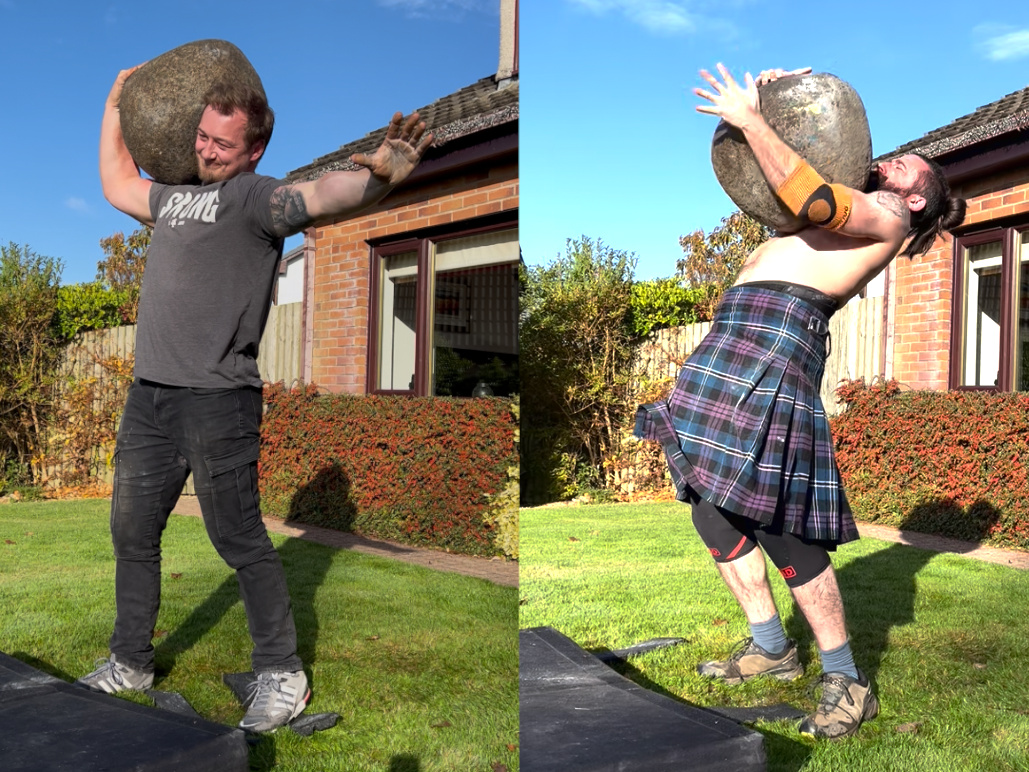
As keen stone lifters, Morgan and I could not help resist the temptation to have a few more lifts of the stone before parting ways. The goal for us was to lift it onto our shoulder. This is not a typical traditional lift by any means, but this is what most modern lifters aspire to achieve with stones of this size. I allowed Morgan to have the first attempt. He got exceptionally close to getting it high enough to “roll” it onto the shoulder, but the unbalanced nature got the better of him.
I stepped up to have my attempt. I managed to get a lot of motion into the stone to “throw” it up my chest and catch it around the shoulder area. I managed to get it onto the shoulder, but with wet grass underfoot, it too got away from me and I had to put it down onto the crash pad. Shouldering a stone can be extremely difficult, with many varying techniques. It all depends on the shape of the stone and how you get it high enough on the chest to then push it onto the shoulder. The Old Loans Stone was proving to be a real challenge! Morgan’s second attempt went much like his first - extremely close but just losing the balance at the top again. I managed to stabilise it on my second attempt and got a clean lift to shoulder. With that, we were pretty exhausted from all the efforts of the day. Besides, I don’t think my father would tolerate any more divots in his lawn from the repeated repositioning of the stone!
Relocation
After sitting safely in my parents’ garage while the Loans Village Hall renovated their gardens, the Old Loans Stone moved to the its new home in July 2026, where it sits waiting for visitors to view and lift it.
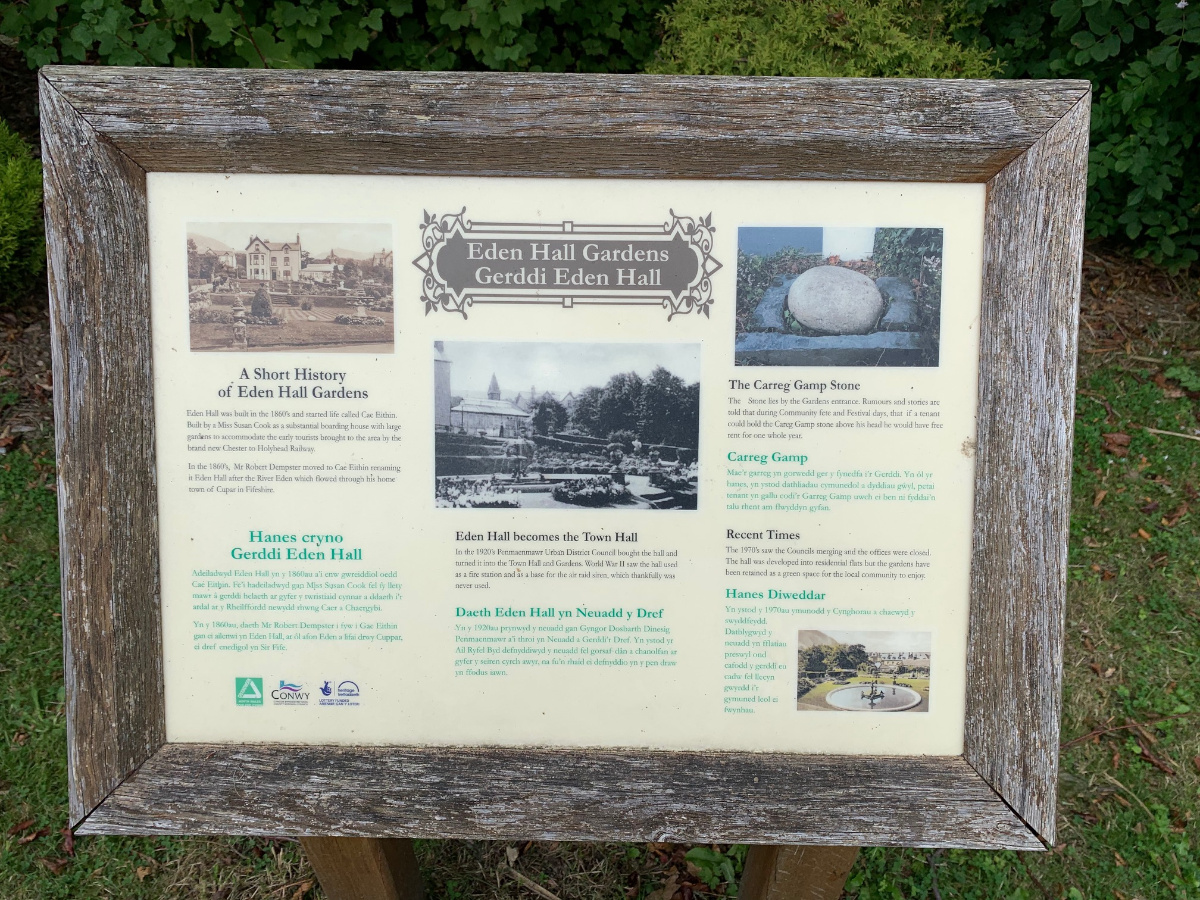
The Community Council installed information boards portraying the history of the village, and they have kindly designated a small area on one of these boards for information about the stone, similar to the information board in the Eden Hall Gardens in Penmaenmawr (Wales) for the “Carreg Gamp” stone.
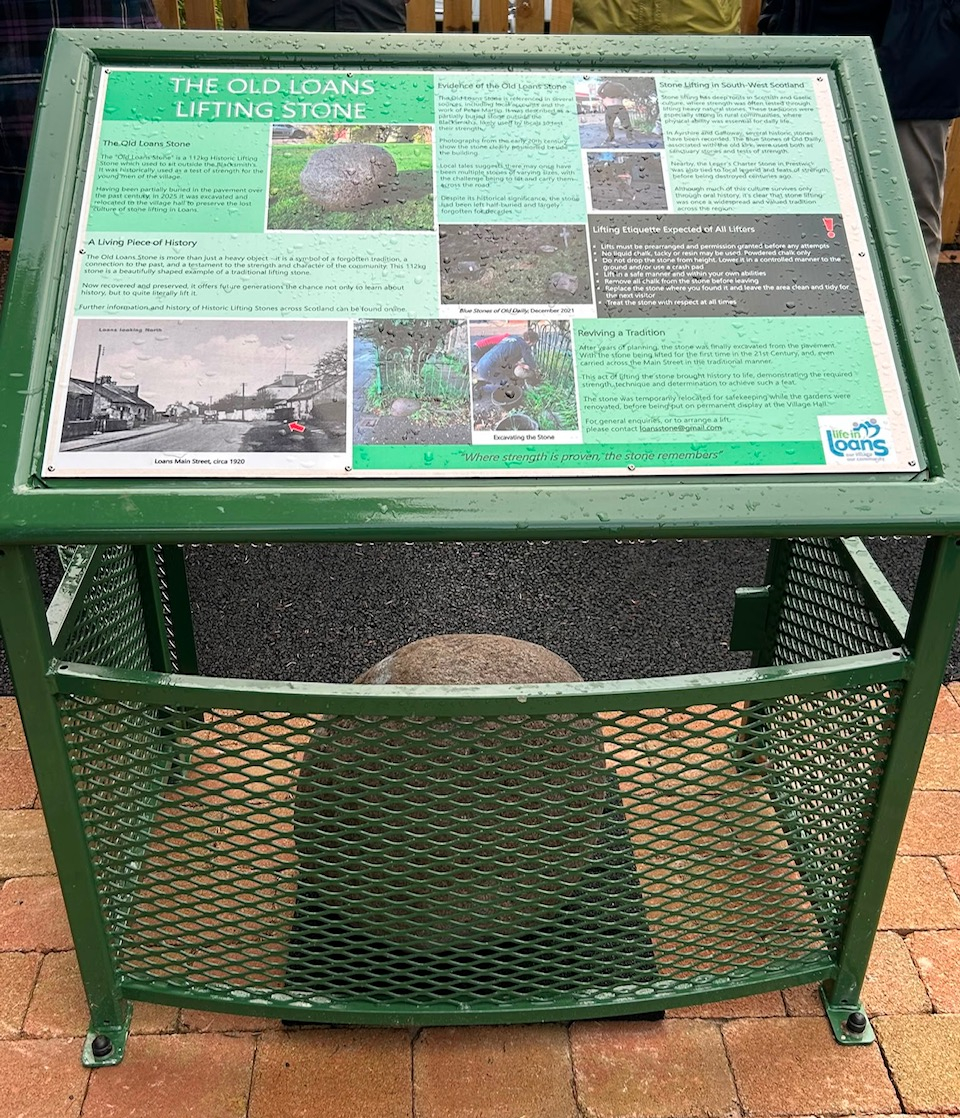
The stone sits outside the hall and is available to all for pre-arranged lifting attempts. The exact location is on the liftingstones.org map. Waivers have to be signed before any attempt, and a record book has been set up to record all successful lifts. Lastly, lifters will be expected to practise good lifting etiquette at all times (see below). Any lifter who fails to do so will be challenged by the keepers. You can arrange a lift using this dedicated email address.
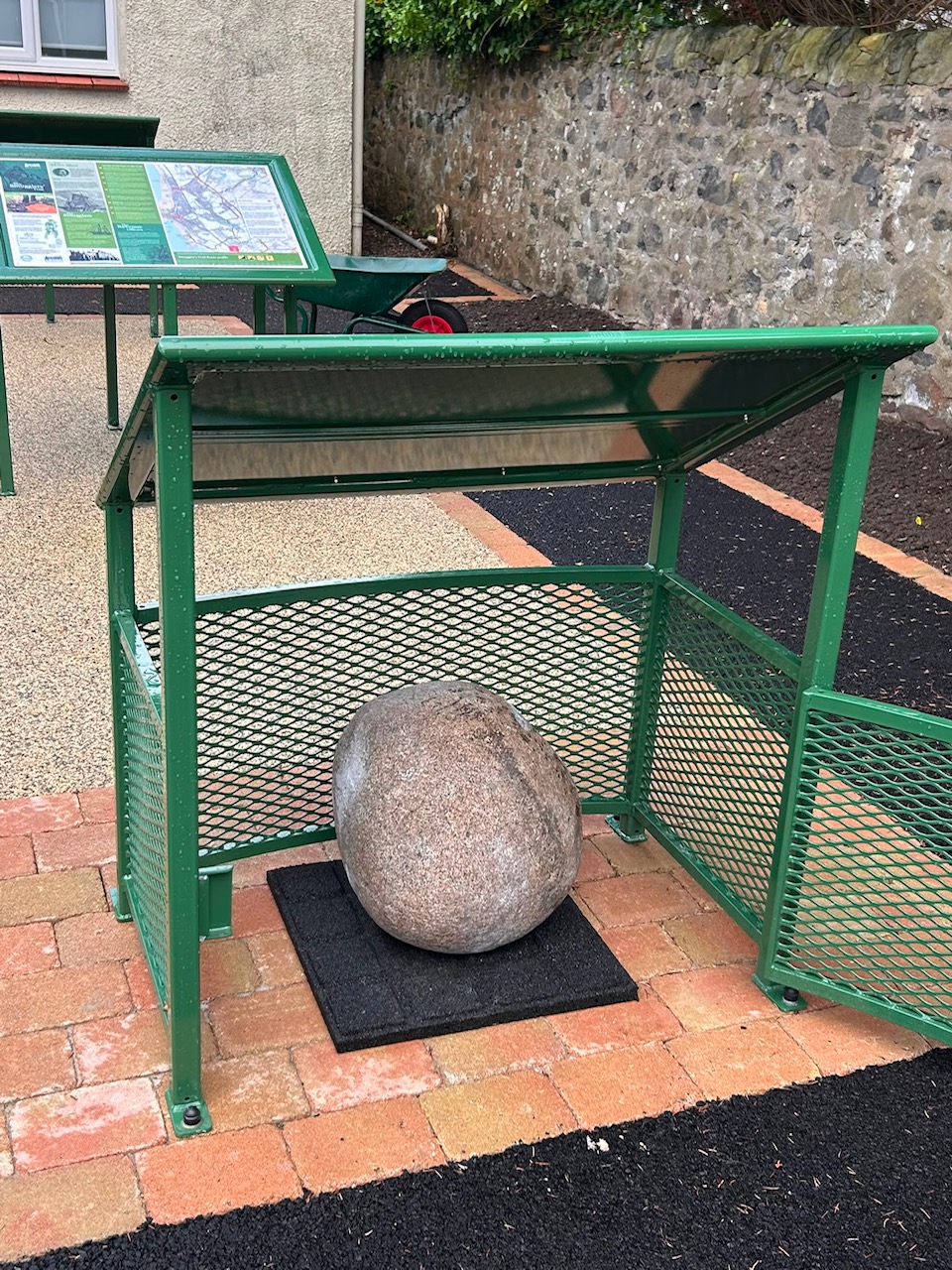
With that, the preservation and continuation of a forgotten lifting culture in Ayrshire has finally been restored. We all must ensure it survives for future generations by playing our part in this incredibly fascinating, rich and challenging tradition.
Personal thank you
This has been a 4-year project for me. However, I could not have done this without a number of people who I have reached out to over the years.
Firstly, this all stems from Peter Martin. His research has allowed all of us to fall in love with this Scottish tradition and resurrect the lifting of lost Historic Stones.
James Grahame, Stevie Shanks, and Martin Jancsics were among the first people I reached out to. Their continued efforts in record keeping, stone logging, arranging lifts and competitions is immensely appreciated by so many of us in the community.
Jamie McGregor and Kara Shaw sent through valuable clues which helped me piece together other references to the stone.
Dane Love, author of Legendary Ayrshire, for both mentioning the stone in his writings and helping to clarify which of his books contained the reference.
David Chalmers, and the Loans Community Council for supporting this project and hosting the stone in the future at the village hall.
Catherine Busby at South Ayrshire Council for supporting the overall project at the village hall.
Morgan Price and Tony Fox for their invaluable help in the physical extraction of the stone. I highly doubt this would have been successful without their contribution.
The great people of Facebook who sent through old photos they had of the village.
The home owners of the old smithy in Loans. Their enthusiasm for the project has been invaluable.
Lastly my amazing family, who have supported me and shared so many of my stone lifting adventures throughout the UK.
Thank you to all of you, and the many others who helped me with this project. It means the world to me knowing the culture of stone lifting in Ayrshire is back!
Where strength is proven, the stone remembers
Lifting etiquette expected of all lifters
- Lifts must be arranged and permission granted before any attempts.
- An unauthorised lift risks lifting permission being removed for all.
- No liquid chalk, tacky or resin may be used on the stone.
- No dropping the stone from height.
- Lower in a controlled manner to the ground, and/or use a crash pad.
- Lift in a safe manner and within your own limits (shoulder, overhead press etc.).
- Treat the stone with respect at all times.
- Remove all chalk from the stone before leaving.
- Replace the stone to where you found it.
- Leave the area clean and tidy for the next visitor.
Author
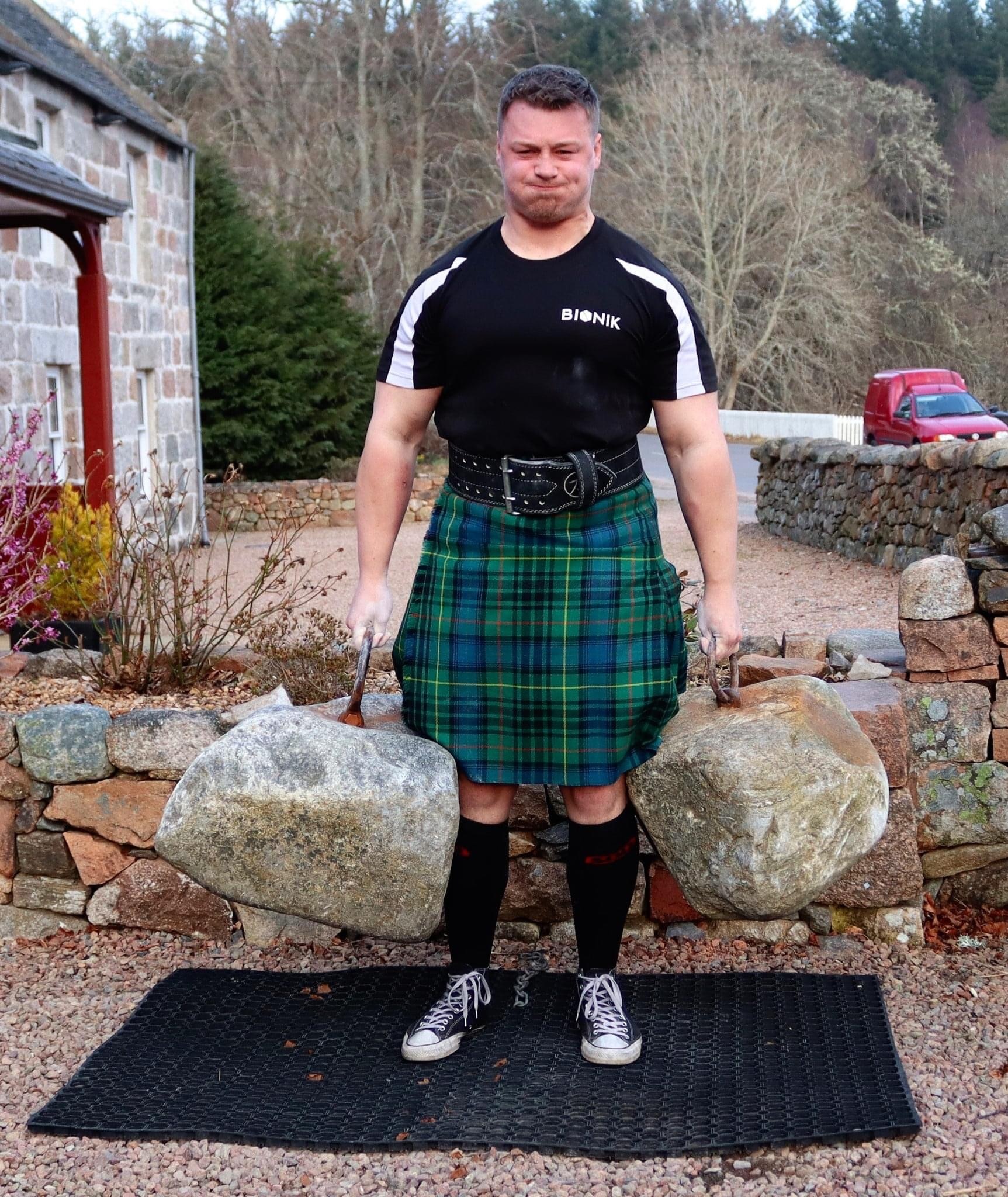
After discovering a passion for historic lifting stones in 2018, David has travelled extensively across the United Kingdom to study their history and successfully lift them. His journey has taken him from the remote Island of Colonsay to the rarely attempted “Clutton Stone” near Bristol, from sharing the legacy of the “Carreg Gamp” in Penmaenmawr to the “Strathmore of Durness”. Blending his love of strength sports with a deep respect for history, he has dedicated himself to preserving and promoting a rich but often overlooked cultural tradition.
References
Email chains between Peter Martin and Dane Love (2012)
Blue Stones of Old Dailly discussion (IronMind)
-
Steve Jeck and Peter Martin, Of Stones and Strength, 1996 ↩
-
Peter Martin, Twixt the Stone and the Turf (.pdf), thedinniestones.com ↩
-
Dane Love, Legendary Ayrshire, 2009, p. 18 ↩
Read the liftingstones.org letters
Join thousands of other stonelifters who read the world's most popular stonelifting newsletter.